
The AI Tool Paradox: Why Having More AI Tools Can Make Us Less Productive
The AI boom has given us thousands of tools for writing, research, design, coding, automation, and more. But having more options does not always mean getting more done. Discover why AI tool overload can hurt productivity and why building focused AI workflows matters more than collecting tools.
AI should save our time. Instead, we’re spending more time deciding which AI to use.
Need to write something? There’s an AI for that. Research something? Another one. Design it, code it, analyze it, turn it into a video, make a presentation, automate it there’s a tool for practically everything.
And every week, there’s another one promising to be faster, smarter, cheaper, or more powerful than the last.
It sounds like progress. But here’s the uncomfortable part:
Having more AI tools doesn’t necessarily make us more productive. Sometimes, it just gives us more things to choose from.
And when choosing the tool becomes part of the work, the technology meant to save us time can start taking it away.
The AI Tool Explosion
The first wave of generative AI was, sort of, pretty simple
You had a problem, you opened an AI assistant. you asked a question, then you got an answer. nothing more, usually.
Now though the whole AI ecosystem feels way different.
Instead of one general assistant, there are thousands of specialized AI tools made for very particular stuff. Like one tool might be excellent at research, another is good for writing, another helps with generating images, and yet another is built for automating workflows.
That kind of focus creates amazing chances, but it also brings a new kind of trouble choice overload.
Because when you have too many options it can feel like selecting the right tool is it’s own job.
So that’s where the AI tool paradox begins, kind of quietly at first, then suddenly everywhere.
When Finding the Right Tool Becomes the Work
So, imagine you are putting together a marketing campaign, right?
You could use one AI tool for audience research, another for idea sparking, another for writing copy, another for visual production, another to make a video, another to inspect performance, and one more to automate distribution.
Each one can be useful, no doubt.
But then you start moving between them and somehow there is friction… like, real low grade annoyance that adds up.
You copy details from one platform and paste into another, you rewrite prompts, you download files, then you upload them somewhere else. You end up learning different interfaces ,and you compare results like it’s a daily ritual.
At some point you realize you’re managing the AI workflow more than you’re actually doing the work itself.
AI was meant to erase repetitive labor. Instead, a badly designed AI workflow can invent a different repetition, one that nobody asked for: constant tool switching, again and again.
The Hidden Cost of bouncing between AI Tools
Jumping from one AI to another can feel kinda harmless, since the change usually takes just a few seconds or minutes.
But productivity is not only time.
Each change also eats up attention.
You end up needing to remember, where your info is stored, figuring out what the next tool is expecting, tweaking your prompt, judging the output , and then deciding if it is truly “better” or just different.
So there’s this sort of tool-switching tax.
The more scattered your workflow becomes, the more mental energy you burn on managing the whole dance, instead of actually making progress. And there’s more.
You might start second guessing every single choice
Is this the most fitting AI model
Would another tool give you a stronger result
Should you chase the newest version
Maybe there’s an AI that is built specifically for this task
That never ending optimization can turn into a distraction all on its own.
More AI doesn’t always mean more productivity
So there’s this big, kind of persistent misunderstanding about AI adoption.
We tend to believe that if we add more tools, then we get more abilities, which then equals more output. But it is not really that clean. The link between “more” and “better” can get tangled fast.
A more realistic equation might be, productivity = the right tools + the right workflow + the right execution
Because a tool is not automatically useful just because it’s smart. It’s only valuable when it actually helps you walk closer to a real outcome, like deliver the thing, finish the task, reduce friction, whatever applies.
If you bring in another AI application and now you’re stuck with extra decisions, more toggling between systems, and extra overhead everywhere, then those “theoretical” capabilities might not even kick in.
So the top AI tool, isn’t always the one with the longest list of features.
Sometimes it’s the one that slots in naturally with how you already operate, your rhythms, your habits, and your daily flow.
Stop Building Tool Collections. Start Building AI Workflows
The next stage of AI adoption isn’t really about finding more tools. or some other shiny thing every day.
It’s about putting the right tools together into repeatable workflows. in a way that actually stays consistent.
Like a basic content run, something like:
Research → Create → Refine → Design → Publish
Instead of looking for a fresh AI tool at each step, build a steadier system you can fall back on.
Pick tools for what they handle best. not just what sounds trendy.
Write prompts that you can reuse. and not every time from scratch, because that gets messy fast.
Make templates. simple ones at first then more specific later.
Automate the small handoffs when you can , especially the repetitive parts that don’t need much judgement.
Also, note down the whole workflow so you can rerun it without guessing. yeah, documentation , boring but effective.
So the question shifts from:
“Which AI tool should I try today?”
To something like:
“How can I make this workflow quicker and more accurate?”
That’s the better question, and it pays off.
The real AI advantage
The future won’t really belong to the person who just has the most AI tools sitting open in their browser, ready to go.
It’ll go to the person who gets which tools truly matter, how they fit together in practice, and when to not add “one more” tool at all, even if it looks useful.
AI has already shifted the way we make things, how we work, how we investigate, and how we untangle problems.
So, the next hard part isn’t just getting access. It’s learning how to steer all that abundance it created, without getting lost in it.
Because in a web full of AI tools, finding options is no longer the toughest step. Decision-making is.
And the highest productivity edge might not be spotting yet another AI tool.
It may be knowing which ones to leave alone.
Discover the AI ecosystem , without the overload
Since the AI world seems to be shifting day to day, staying on top of things shouldn’t require opening a hundred tabs and saving bookmarks for endless tools.
FutureStoreAI helps you look around the evolving AI ecosystem, find helpful AI tools, and get a clearer picture of what’s actually going on across the field of artificial intelligence.
Whether you want your next go-to AI tool, or you’re just curious about new AI trends, or you’re trying to build a smarter workflow, begin with a bit of discovery that turns into real action.
Wander through the AI ecosystem. Spot the tools that truly matter. Assemble workflows that hold up.
Explore FutureStore AI. Find the tools that matter. Build workflows that work.
FutureStore AI App – Discover & Use Powerful AI Tools
Recommended for you
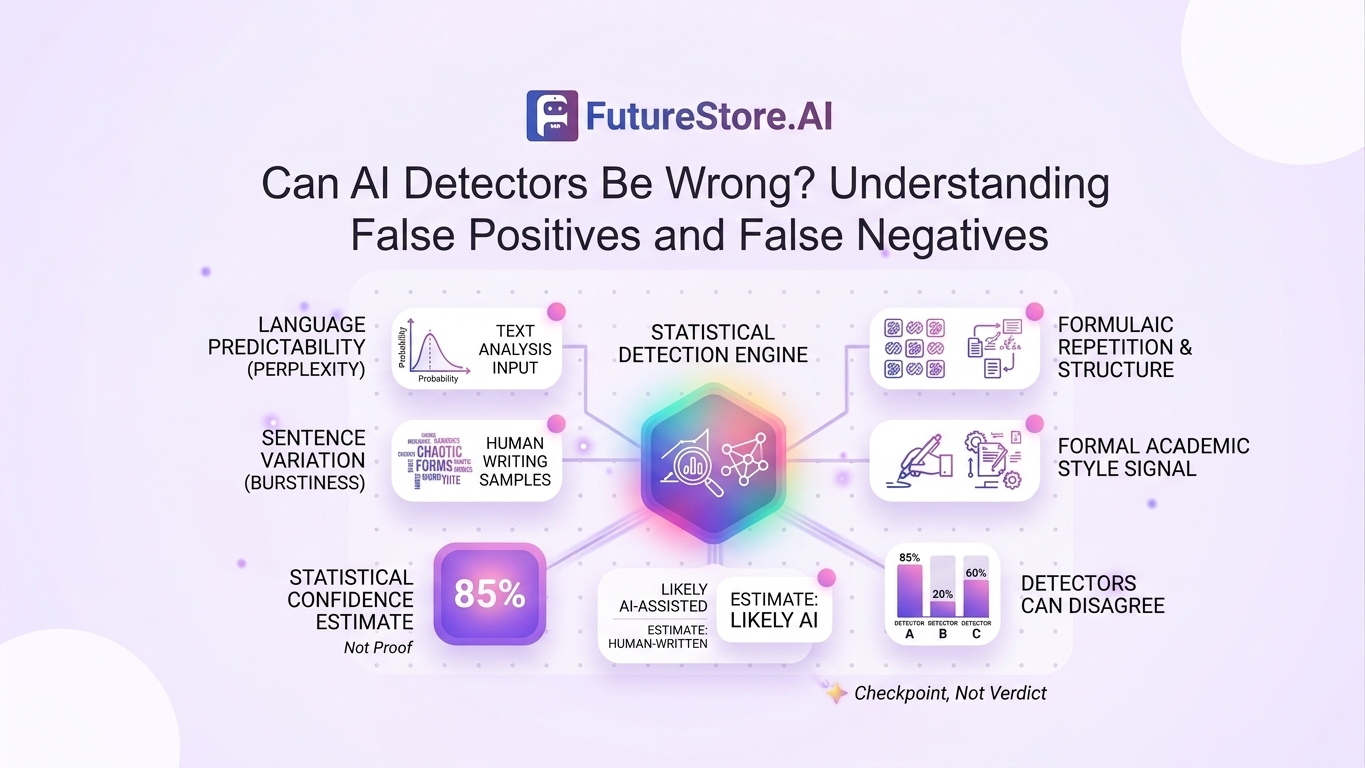
Can AI Detectors Be Wrong? Understanding False Positives and False Negatives
AI detectors can produce both false positives and false negatives. Learn how AI detection works, why results can vary, and why detection scores should be treated as indicators rather than definitive proof of authorship.
.png)
The AI Landscape in 2026: What You Need to Know
Explore the key trends shaping AI in 2026, from rapidly evolving AI models and multimodal systems to AI agents, automation, opensource AI, and the growing role of AI in everyday productivity.
.png)
AI-Powered Quality Engineering: Building the Next Generation of QA Strategy
AI is changing how software is built, tested, and released. For QA teams, the opportunity is not to replace traditional testing, but to make quality engineering smarter, faster, and more risk-focused. This article explores practical ways teams can use AI across the software testing lifecycle while keeping human judgment at the center.