
Can AI Detectors Be Wrong? Understanding False Positives and False Negatives
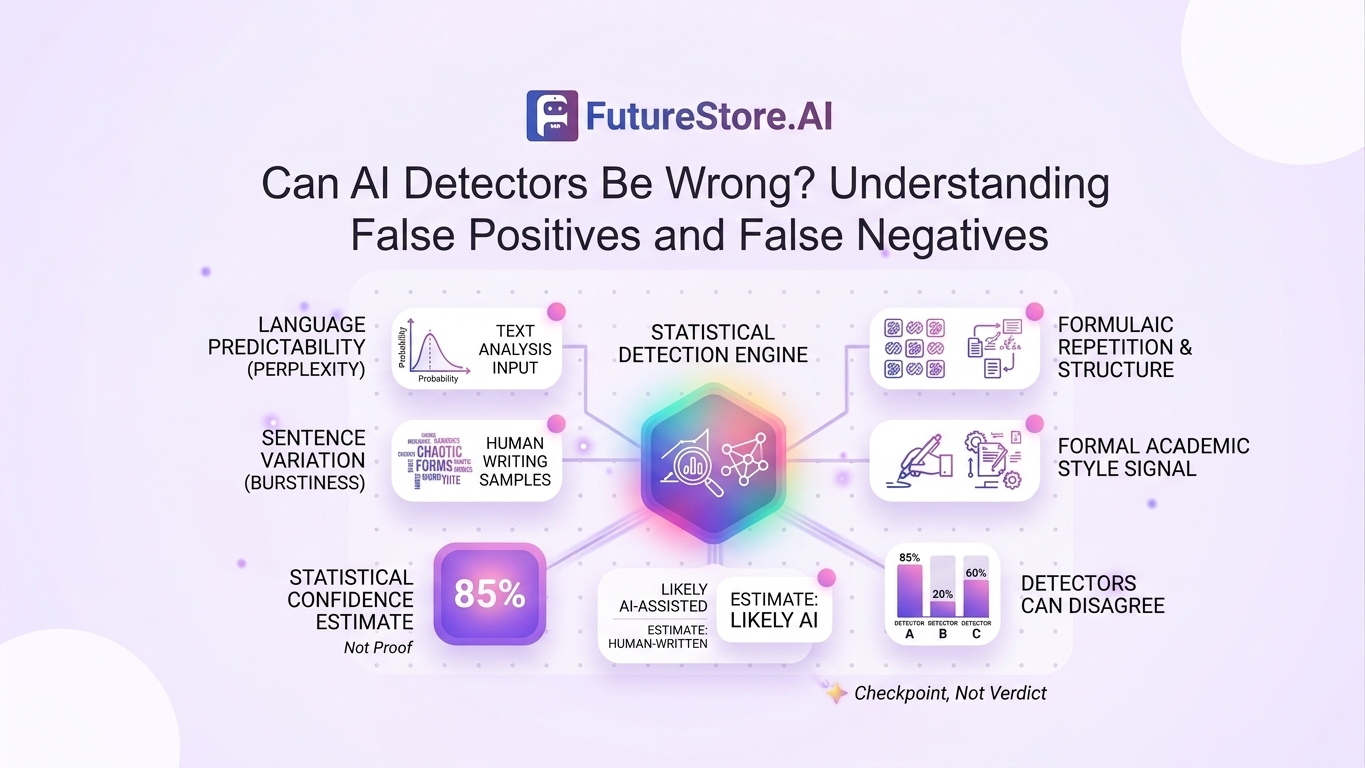
AI detectors can produce both false positives and false negatives. Learn how AI detection works, why results can vary, and why detection scores should be treated as indicators rather than definitive proof of authorship.
AI writing tools have quickly become part of everyday content creation. From brainstorming ideas and improving grammar to summarizing reports, drafting articles, and writing emails, people use AI across both professional and academic settings.
As AI-generated content has become more common, AI detectors have grown in popularity as well. These tools analyze text and estimate whether it resembles human or AI-generated writing.
However, one important question often comes up: Can AI detectors actually be wrong?
The short answer is yes. AI detectors can produce both false positives and false negatives. Their results are statistical estimates based on language patterns, not definitive proof of who or what wrote a piece of text. Understanding these limitations is important before relying heavily on an AI detection score.
What Is an AI Detector?
An AI detector is a software tool that analyzes text and estimates whether it shows patterns associated with AI-generated writing. Different tools use different methods, but they may analyze factors such as:
Word and sentence patterns: Looking at how predictably words and sentences are structured.
Language predictability: Measuring characteristics such as perplexity, which can indicate how predictable word choices are.
Sentence variation: Analyzing differences in sentence length and structure, sometimes referred to as burstiness.
Repetition and structure: Looking for repetitive or formulaic phrasing.
Statistical patterns: Comparing linguistic characteristics with patterns found in human and AI-generated text.
Machine-learning models: Using trained models to classify text based on learned patterns.
After analyzing the text, a detector may provide a percentage, confidence score, or label such as "Likely AI."
However, these results should be treated as indicators rather than definitive conclusions about authorship.
What Is a False Positive?
A false positive occurs when an AI detector incorrectly identifies human-written text as AI-generated.
For example, imagine a student writing an essay entirely on their own. If the writing is highly structured, grammatically polished, and uses standard academic language, it may contain some of the patterns that a detector associates with AI-generated text.
As a result, the detector may assign the essay a high AI probability score even though it was written entirely by a person. That is a false positive.
Why Do False Positives Happen?
The main reason is that human writing can naturally share characteristics with AI-generated writing.
Human content may be more likely to trigger a detector when it is:
Highly structured: Uses predictable formats or formulaic organization.
Grammatically polished: Contains few errors or informal expressions.
Formal or academic: Uses standard terminology and conventional writing styles.
Short and straightforward: Uses simple and predictable sentence structures.
Repetitive in sentence structure: Contains similar sentence lengths or patterns.
Written by non-native English speakers: Uses conventional grammatical structures that some detectors may interpret as patterns associated with AI-generated text.
A detector flag does not necessarily mean that the text was generated by AI. It means the writing contains characteristics that the particular detector associates with AI-generated content.
What Is a False Negative?
A false negative occurs when AI-generated or AI-assisted content is not flagged by an AI detector.
For example, a writer might use an AI tool to create an initial draft, brainstorm ideas, rewrite certain sections, or improve the wording. The writer may then substantially edit the content by changing the wording, adding personal examples, reorganizing the structure, and rewriting entire sections.
In this situation, the final text may contain a combination of human-written and AI-assisted content. Because substantial editing can change the linguistic patterns of the original AI-generated text, some detectors may have difficulty identifying the AI involvement. The final text may therefore receive a low AI probability score even though AI was used during the writing process.
This does not necessarily mean the detector has determined that the text was entirely human-written. It means the final version did not show enough of the patterns that the particular detector associates with AI-generated content.
Why Can AI-Generated or AI-Assisted Content Be Hard to Detect?
AI-generated text can vary depending on the model, prompt, editing, and context. A user may also revise the output before publishing it, making the final version different from the original AI response.
For example, a writer might:
Rewrite AI-generated sentences.
Add personal examples or original information.
Change structure and tone.
Combine AI-generated and human-written sections.
These changes can make the final text harder for a detector to classify accurately. A detector analyzes the final text it receives; it does not have access to the complete history of how that text was created.
Why Can Human Writing Look Like AI?
Human writing can also contain predictable patterns. This is particularly common in professional, technical, medical, and academic writing, where writers often follow established structures and terminology.
A typical structure might look like:
When people write within these formal structures, they naturally use consistent grammar, common terminology, and familiar sentence patterns. These characteristics are not exclusive to AI-generated content.
As a result, an entirely human-written article can sometimes trigger the same statistical signals that a detector associates with AI-generated text.
AI Detector Scores Are Not Proof
To understand AI detection, it is important to know what the reported percentages actually mean.
For example, suppose a detector reports that 85% of a piece of text is likely AI-generated. The meaning of a score depends on how the particular detector calculates and presents it. A percentage should therefore not automatically be interpreted as the probability that AI wrote the entire document.
The meaning of the score depends on how that particular detector defines and calculates its results. In general, a score reflects how the analyzed text matches patterns that the particular tool associates with AI-generated writing.
It should therefore not be treated as definitive evidence of authorship. Different AI detectors can also analyze the same text and produce different results.
AI Detectors Can Disagree
Different detectors can produce different results for the same piece of text. One tool might classify a paragraph as likely AI-generated, while another might classify the same paragraph as human-written.
This can happen because different tools use their own:
Detection models: Different models and technical approaches for analyzing text.
Training datasets: Different collections of human and AI-generated writing.
Statistical methods: Different ways of weighing linguistic characteristics.
Sensitivity thresholds: Different standards for when text is flagged.
Definitions of AI-like writing: Different interpretations of the characteristics associated with AI-generated content.
As AI models and writing styles continue to change, detection systems also face the challenge of adapting to new types of generated text.
AI Detection Is Not Plagiarism Detection
AI detection and plagiarism detection are designed to answer different questions.
Plagiarism detection: Compares text against available web pages, publications, academic databases, or other sources to identify matching or similar material.
AI detection: Analyzes characteristics of the writing to estimate whether it resembles AI-generated text.
Because of this difference, original human-written content can receive a high AI score without containing plagiarized material.
Likewise, copied content can be identified as similar to an existing source regardless of whether it was originally written by a human or generated using AI.
The two types of tools therefore serve different purposes in the content-review process.
Use the Score as a Checkpoint, Not a Verdict
AI detectors can still be useful when their limitations are understood. Instead of treating a high score as a final verdict, use it as a checkpoint for further review.
If a detector flags your content, look beyond the percentage and examine the text itself. Consider questions such as:
How was the content created?
Was AI used during drafting or editing?
Was the text translated or heavily revised?
Does the result make sense in context?
Could technical terminology, formal writing, or structured formatting have affected the result?
The goal should be to understand why the text was flagged rather than blindly accepting or rejecting the score.
How FutureStoreAI Fits Into This Workflow
FutureStoreAI is an AI ecosystem that brings together AI discovery, experimentation, learning, creation, and publishing. Its AI Detector gives users a practical way to explore how AI detection works and understand the signals that detection systems associate with AI-generated or AI-assisted writing.
Rather than treating an AI detection score as proof of who wrote a piece of content, the detector can be used as a checkpoint during the content-review process. It can help users examine how different writing styles, revisions, and levels of AI assistance may affect detection results.
The goal is not simply to obtain a percentage. Instead, the result can be considered alongside the content's context, how it was created, and any human editing or revision that took place.
Explore the FutureStoreAI AI Detector to test text and explore AI-detection signals in practice.
Final Thoughts
AI detectors can be useful, but their results are not infallible.
A human-written piece can be incorrectly flagged as AI-generated, while AI-generated or AI-assisted content can sometimes avoid detection. Different detectors can also produce different results because they use different models, datasets, methods, and thresholds.
Most importantly, an AI detection score should not be treated as definitive proof of authorship. It is an estimate based on characteristics of the text being analyzed.
For writers, educators, businesses, publishers, and content professionals, the most responsible approach is to treat AI detection as one source of information within a broader human review process.
Recommended for you
.png)
Introducing the New FutureStoreAI Overview: Discover What’s New in Our Latest Video Demo
A quick walkthrough of the latest FutureStoreAI updates, showcasing our searchable tool directory, built-in creation studio, real-time AI market analytics, and new creator feature set.

From Scattered Data to Qualified Leads: Building an AI Event Partnership Pipeline
How automated discovery, web scraping, data extraction, qualification, lead scoring, and CSV export turn scattered online information into structured partnership leads.

AI Detectors Deep Dive: How AI Content Detection Actually Works
Explore how AI content detectors analyze text using perplexity, burstiness, machine learning, and stylometric signals and why their results should be treated as estimates rather than definitive proof of AI authorship.