
From Scattered Data to Qualified Leads: Building an AI Event Partnership Pipeline
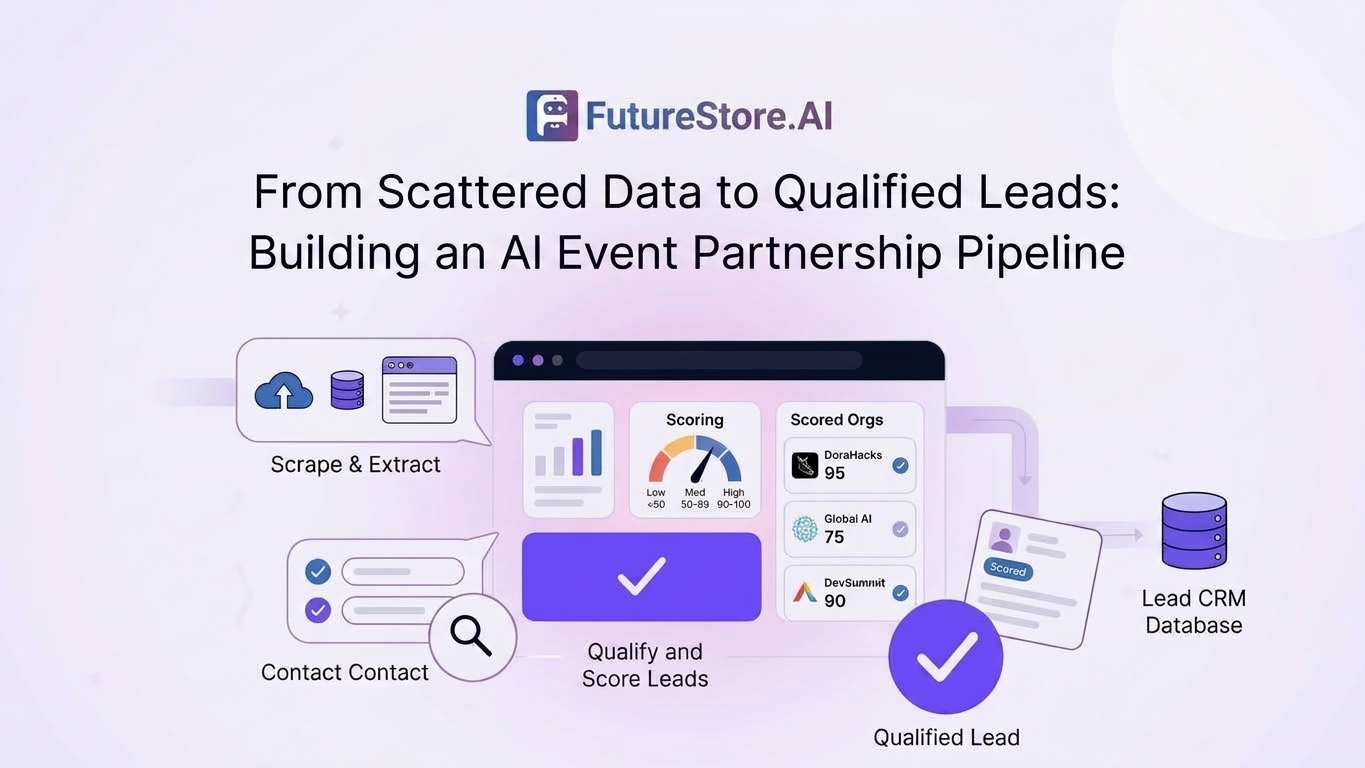
How automated discovery, web scraping, data extraction, qualification, lead scoring, and CSV export turn scattered online information into structured partnership leads.
Introduction
Finding AI event organizers sounds simple until the research starts.
A partnership researcher may need to search for AI conferences, meetup communities, hackathons, accelerators, universities, nonprofits, associations, and startup communities.
For every organization, they may then need to find:
Official website
Event activity
Social profiles
Contact information
Partnership opportunities
Sponsorship opportunities
Speaker opportunities
Exhibitor opportunities
CFPs and community channels
Doing this manually becomes repetitive and time-consuming, especially when the goal is to research dozens or hundreds of organizations.
That was the problem behind the AI Event Organizer Lead Generator.
The goal was to build an automated pipeline that:
Discovers organizations → collects information → qualifies leads → scores them → sorts them → exports them into a structured CSV.
This type of automation fits naturally into the broader AI ecosystem offered by FutureStore AI, where organizations and professionals can discover AI products, experiment with AI, and follow AI ecosystem activity.
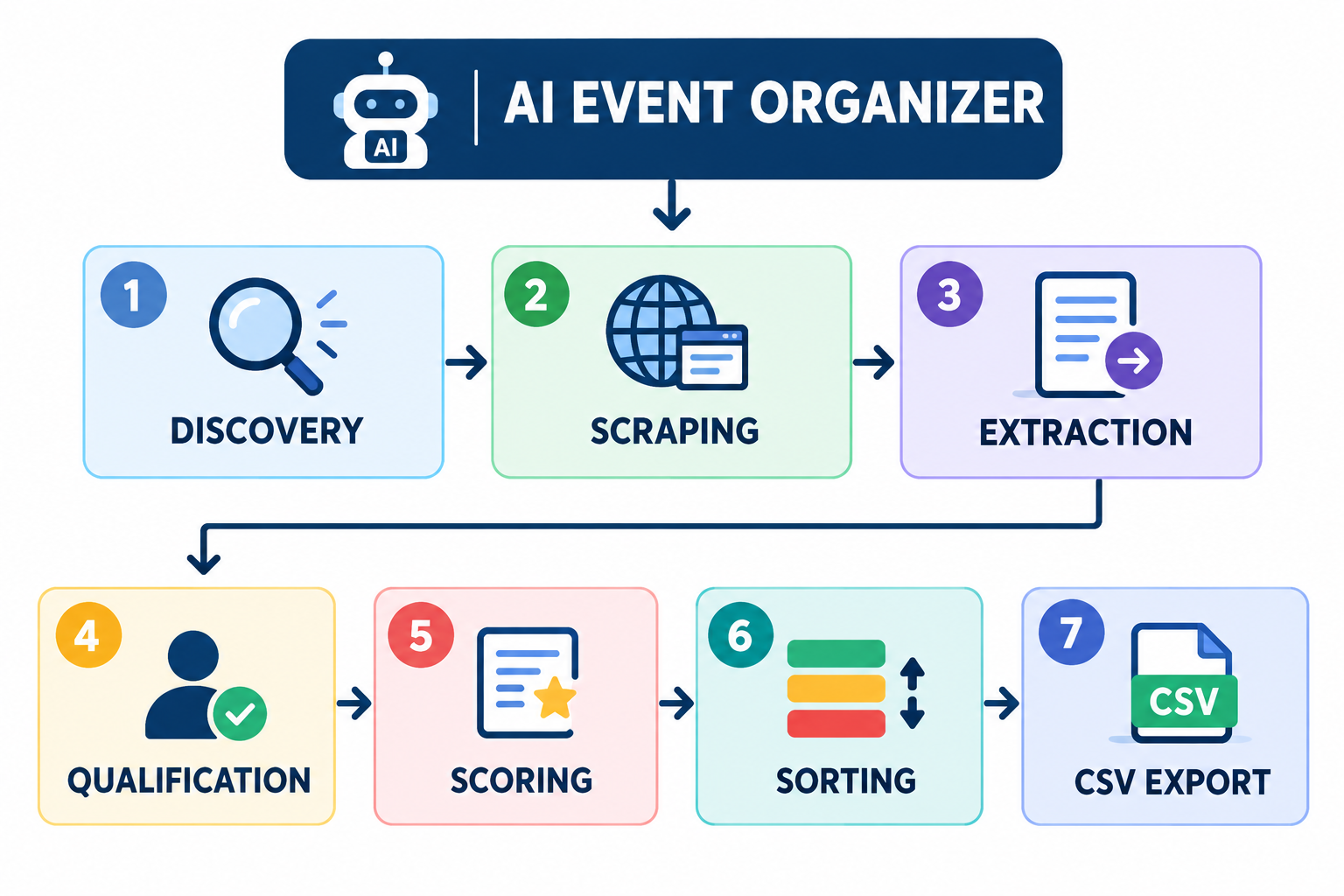
The pipeline is connected through a scheduler that coordinates each stage and produces a ready-to-use partnership research dataset.
01. The Problem With Manual Lead Research
Imagine researching AI-event organizations manually.
The process might begin with searches such as:
AI conference organizers
AI meetup communities
AI hackathon organizers
AI accelerator programs
AI incubators
University AI events
AI nonprofit communities
Startup communities
Technology associations
After finding an organization, the researcher may need to visit its website and look for:
Contact email
Phone number
Partnership page
Sponsorship opportunities
Upcoming events
Speakers
CFPs
Exhibitors
LinkedIn
X/Twitter
YouTube
Discord
Slack
GitHub
Newsletter
Repeating this process for every organization creates the same problem again and again:
Search → Open → Inspect → Copy → Organize → Repeat
Automation helps turn this repetitive workflow into a repeatable data pipeline.
02. What the Pipeline Actually Does
Instead of solving everything in a single script, the project divides the workflow into smaller stages.
Each stage has a specific responsibility:
Discovery
Find potential organizations.
Scraping
Collect information from organization websites.
Extraction
Transform raw website information into structured fields.
Qualification
Identify signals that indicate partnership potential.
Scoring
Convert those signals into a lead score.
Sorting
Organize organizations by their score.
Export
Generate a structured CSV for further use.
This modular approach makes the system easier to maintain, debug, and extend.
For additional context on the platform behind this project, see the FutureStore AI About page.
03. Discovering AI Event Organizations
The discovery layer uses a two-layer approach.
Seed Organizations
A curated seed list provides known organizations to start with.
Examples include:
Global AI Community
AI Tinkerers
Generative AI UK Community
lablab.ai
ODSC
AI Hackathon @ Berkeley
AI DevSummit / DevNetwork Hackathon
Y Combinator
Techstars
NVIDIA Inception
Antler
Technovation
USAII Global AI Hackathon
Stanford Data Science / HAI Events
This gives the pipeline a reliable starting point instead of depending entirely on search results.
Search-Based Discovery
The pipeline can also use a search API to discover additional organizations from queries such as:
"AI conference organizer"
"AI meetup community"
"AI hackathon organizer"
"AI accelerator program"
"AI incubator"
This makes the system expandable beyond the initial seed list.
Example discovery output:
seed_list : 14 curated organizations
query     : "AI hackathon organizer"
found     : 9 additional candidates
name      : DoraHacks
source    : search + seed match
The combination of curated organizations and search-based discovery allows the system to balance reliability and scalability.
04. Avoiding Duplicate Organizations
Search results can easily surface the same organization multiple times.
For example, one organization might appear under:
AI conference organizer
AI event organizer
AI meetup community
Treating these results as separate organizations would create duplicate leads and could eventually result in contacting the same organization multiple times.
The pipeline therefore uses the organization's domain as a deduplication key.
For example:
https://example.org
https://www.example.org/events
https://example.org/sponsors
can all be mapped back to the same organization.
This keeps the final dataset cleaner and more useful.
05. Scraping Organization Profiles
Once candidates have been discovered, the pipeline visits their websites and collects information relevant to partnership research.
The objective is not simply to download webpage text.
The useful information needs to be transformed into structured fields such as:
Organization
Name, website, country, city, and organization type.
AI Focus
AI specialization and technology focus.
Events
Events per year and latest event.
Social
LinkedIn, X/Twitter, and YouTube.
Contact
Email and phone.
Partnerships
Partnership page and sponsorship availability.
Opportunities
Speakers, CFPs, and exhibitors.
Communities
Newsletter, Discord, Slack, and GitHub.
This approach is similar to the structured discovery experience available through the FutureStore AI Directory, where AI products are organized into searchable categories rather than presented as unstructured information.
The scraper therefore acts as the collection layer for the broader lead-generation system.
06. Turning Web Data Into Structured Records
Raw webpages are inconsistent.
One organization may have:
/partners
Another may use:
/sponsors
Another may simply place:
Become a sponsor
on its homepage.
The pipeline converts these different website structures into a common schema that the rest of the system can process consistently.
Organization Information
Name, website, country, city, and organization type.
Event Information
Event frequency and latest event.
Contact Information
Email and phone.
Partnership Opportunities
Partnership page, sponsorship availability, and exhibitor opportunities.
Social Information
LinkedIn, X/Twitter, and YouTube.
Lead Qualification
Score and priority.
Metadata
Source and scrape timestamp.
Example structured record:
email             : partners@dorahacks.io
sponsorship_page  : Yes
exhibitors        : No
speakers          : Yes
The important shift is from unstructured web pages to machine-readable business records.
07. Qualifying Potential Leads
Finding an organization does not automatically make it a useful partnership lead.
The pipeline looks for signals that indicate relevance for outreach.
Qualification signals:
Is a contact email available?
Is there a partnership or sponsorship opportunity?
Does the organization run multiple events?
Are exhibitors supported?
Are speaking opportunities available?
Is there a CFP?
Does the organization have an active community?
These signals become inputs to the lead-scoring stage.
The goal is not to claim that a lead will definitely convert, but to consistently identify organizations that match predefined partnership criteria.
08. Lead Scoring
The pipeline converts collected signals into a numerical lead score capped at 100.
Scoring rules:
Contact email available                : +20
Partnership / sponsorship opportunity  : +20
5+ events per year                     : +20
10K+ LinkedIn followers                : +10
Exhibitor opportunity                  : +15
Speaker / CFP opportunity              : +15
The resulting score is mapped into three priority levels.
High: Score 90 to 100
Medium: Score 50 to 89
Low: Score below 50
These rules are implemented in score.py.
The scoring system provides a consistent way to organize large numbers of leads using the same criteria.
09. Example Leads
The generated research data can contain organizations discovered from both verified research and search-based discovery.
DoraHacks
A record may include:
Hackathon information
Social channels
Contact email
Discord community
AI DevSummit / DevNetwork Hackathon
A record may include:
Hackathon website
Social information
Sponsorship page
Instead of maintaining scattered browser tabs, screenshots, and notes, the information becomes a structured lead record that can be filtered, sorted, and processed programmatically.
10. Sorting the Leads
After every organization has been scored, the pipeline sorts the records by lead_score.
The highest-scoring organizations appear first in the final dataset.
Example:
95
90
75
40
...
The sorting stage is performed before CSV export.
11. Exporting the Final CSV
After processing, the pipeline writes the results to:
output/ai_event_organizers.csv
The exporter follows a predefined column structure so every organization is represented consistently.
The generated CSV can then be opened in:
Microsoft Excel
Google Sheets
Python
CRM systems
Data-processing workflows
Other automation tools
Example output:
DoraHacks
Country: Global
Score: 95
Priority: High
AI DevSummit
Country: USA
Score: 90
Priority: High
lablab.ai
Country: Global
Score: 75
Priority: Medium
Campus AI Club
Country: Nepal
Score: 40
Priority: Low
The result is a dataset that can move directly from research into downstream partnership workflows.
12. Handling Missing Information
Real-world websites rarely provide complete information.
A website may have:
No public email
No phone number
No partnership page
No LinkedIn follower count
No sponsorship details
No clearly published event frequency
The system does not assume that missing information exists.
Instead, unavailable fields remain blank while all verified information is preserved.
This is especially important for automated research.
A lead-generation system is only useful when its data remains trustworthy. Fabricating missing contact information would make the dataset less reliable.
13. Project Architecture
The project is divided into modules, with each file responsible for a specific part of the workflow.
Project structure:
partnership_leads/
│
├── discover.py
│   └── Finds candidate organizations
│
├── scrape_profile.py
│   └── Collects information from organization websites
│
├── extract_contacts.py
│   └── Extracts useful contact information
│
├── score.py
│   └── Calculates lead scores and priority
│
├── export_csv.py
│   └── Creates the final CSV file
│
├── scheduler.py
│   └── Connects the pipeline components
│
└── output/
    └── ai_event_organizers.csv
This modular structure means each component can be improved independently without rewriting the entire application.
14. Connecting Everything With the Scheduler
The scheduler acts as the controller of the complete pipeline.
Complete execution flow:
discover_candidates()
        |
        v
scrape_organization()
        |
        v
extract_contacts()
        |
        v
score_lead()
        |
        v
sort by lead_score
        |
        v
export_leads()
The scheduler makes sure that each stage runs in the correct sequence.
This transforms several independent scripts into one coordinated workflow.
15. Manual Research vs. Automated Research
The major advantage is not simply speed.
It is consistency.
Every organization can be processed using the same fields, extraction logic, qualification criteria, and scoring rules.
Manual workflow:
Search
  ↓
Open website
  ↓
Find information
  ↓
Copy information
  ↓
Update spreadsheet
  ↓
Repeat
Automated workflow:
Discovery
  ↓
Scraping
  ↓
Extraction
  ↓
Qualification
  ↓
Scoring
  ↓
Sorting
  ↓
CSV Export
Automation reduces repetitive work while creating a more standardized dataset.
16. Why Lead Scoring Matters
Suppose the pipeline discovers 200 organizations.
A researcher may not want to inspect all 200 immediately.
Without scoring:
Organization A
Organization B
Organization C
...
Organization Z
With scoring:
Organization → Score → Priority
This adds another layer of structure to the dataset.
The score is not a guarantee that an organization will become a successful partnership. It is simply a rule-based method for organizing leads according to observable signals.
17. Making the Pipeline Repeatable
The project does not have to remain a one-time script.
The scheduler can be used for:
One-off execution
Recurring discovery
Repeated scraping
Lead updates
Recalculation of scores
CSV regeneration
Recurring workflow:
Discover new organizations
        ↓
Scrape websites
        ↓
Update organization data
        ↓
Extract new signals
        ↓
Recalculate scores
        ↓
Sort leads
        ↓
Export refreshed CSV
Over time, this turns the project into a continuously refreshed partnership research system rather than a static dataset.
For broader AI ecosystem monitoring and continuously changing AI data, FutureStore AI Live provides another example of turning distributed AI ecosystem information into a structured, accessible interface.
18. What I Learned From Building It
Discovery Is Harder Than It Looks
Finding relevant organizations requires more than a single search query. Seed data, multiple query types, and deduplication are important for building a useful discovery layer.
Web Data Is Inconsistent
Different organizations structure their websites differently. A robust scraper therefore needs to work with multiple page layouts and naming conventions.
Structured Schemas Matter
Defining the fields before collecting information makes the final dataset much easier to process and consume.
Automation Needs Validation
A scraper can collect information, but collected information is not automatically correct or useful. Extraction and qualification should therefore be treated as separate stages.
Scoring Turns Data Into Something Actionable
A large dataset becomes easier to work with when observable signals are converted into a consistent scoring system.
Modular Code Is Easier to Improve
Separating discovery, scraping, extraction, scoring, scheduling, and export makes it possible to improve individual components without rewriting the entire application.
Final Thoughts: The Bigger Picture
The AI Event Organizer Lead Generator is more than a scraper.
It demonstrates how an automation workflow can transform:
Unstructured web information → Structured business data → Qualified partnership leads
The complete pipeline can be represented as:
                    INTERNET
                       |
                       v
            DISCOVERY OF ORGANIZATIONS
                       |
                       v
             SCRAPING & EXTRACTION
                       |
                       v
              LEAD QUALIFICATION
                       |
                       v
                 LEAD SCORING
                       |
                       v
                SORT & FILTER
                       |
                       v
                  CSV EXPORT
Finding partnership opportunities manually requires repeated searching, copying, checking, and organizing.
The AI Event Organizer Lead Generator turns that repetitive process into an automated pipeline:
Discover organizations → collect information → transform it into structured records → evaluate partnership signals → calculate a lead score → sort the results → export a usable CSV.
That is where automation becomes valuable: not simply by collecting more data, but by turning scattered information into structured intelligence that a team can actually work with.
For more AI ecosystem research and related insights, explore the FutureStore AI Blog.
Recommended for you
.png)
Introducing the New FutureStoreAI Overview: Discover What’s New in Our Latest Video Demo
A quick walkthrough of the latest FutureStoreAI updates, showcasing our searchable tool directory, built-in creation studio, real-time AI market analytics, and new creator feature set.
Can AI Detectors Be Wrong? Understanding False Positives and False Negatives
AI detectors can produce both false positives and false negatives. Learn how AI detection works, why results can vary, and why detection scores should be treated as indicators rather than definitive proof of authorship.
AI Detectors Deep Dive: How AI Content Detection Actually Works
Explore how AI content detectors analyze text using perplexity, burstiness, machine learning, and stylometric signals and why their results should be treated as estimates rather than definitive proof of AI authorship.