
AI Detectors Deep Dive: How AI Content Detection Actually Works
Explore how AI content detectors analyze text using perplexity, burstiness, machine learning, and stylometric signals and why their results should be treated as estimates rather than definitive proof of AI authorship.
Artificial Intelligence (AI) has completely transformed how we create and consume online content. From drafting blog posts and professional emails to generating essays, reports, product descriptions, and social media updates, AI writing tools can now produce polished text in a matter of seconds.
However, this rapid growth introduces a critical challenge: How can we distinguish between human-written and AI-generated content?
This is exactly where AI content detectors come into play.
Rather than simply scanning a document to "recognize" ChatGPT or other language models, these tools look for underlying patterns in the text. They rely on advanced statistical analysis and machine learning algorithms to predict the likelihood of machine involvement.
Understanding the inner workings of these detection systems is essential for students, educators, business owners, publishers, marketers, and anyone else regularly interacting with digital content.
What Is an AI Content Detector?
At its core, an AI content detector is a specialized software application that analyzes text to estimate the probability that it was generated or significantly assisted by an AI language model.
Unlike traditional plagiarism checkers, an AI detector doesn't look for direct matches with existing content on the web. Instead, it evaluates your text by analyzing key linguistic characteristics:
Predictability: How likely a specific word is to follow the previous one.
Sentence Structure: The complexity and arrangement of your clauses.
Sentence Variation: The diversity of sentence lengths throughout the piece.
Repetitive Patterns: The over-reliance on certain phrases or transitional words.
Vocabulary and Phrasing: The depth and variety of the word choice.
Statistical Benchmarks: Comparative analysis against massive datasets of known human and AI-generated text.
The system combines these signals to produce an assessment, often presented as a score, percentage, or classification such as “Likely AI-Generated.”
However, it is crucial to understand that an AI score is an estimation, not definitive proof of authorship. Modern detectors merely flag linguistic patterns typically associated with machine-generated writing; they cannot actually observe the physical process of how your content was created.
How Does AI Content Detection Work?
To evaluate a piece of writing, AI detection systems can use several technical approaches, including:
1. Perplexity (Word Predictability)
Perplexity measures how predictable a word or ‘token’ is within a sequence. Large language models generate text by predicting likely next tokens based on the context. AI-generated text can sometimes show lower perplexity, meaning the word choices are more predictable.
Perplexity alone cannot reliably determine whether text was written by an AI or a human, since people can also produce highly predictable language, particularly in technical, academic, or formal writing.
2. Burstiness (Sentence Variation)
Burstiness analyzes the variation in sentence length and structure throughout a document. Human writing can vary considerably in sentence length and structure, while some AI-generated text may show more consistent patterns.
In contrast, AI text often follows a highly consistent, monotonous rhythm. While detectors use this rhythm as a strong indicator, sentence variation alone is not enough to accurately judge authorship.
3. Machine Learning Classifiers
Many AI detection tools use machine learning models trained on datasets containing human-written and AI-generated text.
By analyzing these datasets, the software learns to recognize subtle, systemic differences between the two styles. Because every detection platform uses its own unique training data, algorithms, and sensitivity thresholds, a single piece of text will often return vastly different scores across different platforms.
4. Stylometric Analysis
Finally, detectors may analyze broader aspects of writing style, including:
Vocabulary Diversity: The range and uniqueness of the words used.
Structural Punctuation: How commas, dashes, and periods are deployed to pace the text.
Word and Phrase Frequency: The over-reliance on specific transition words or repetitive phrases.
Grammatical Choices: Distinct syntax patterns and structural preferences.
Ultimately, detection systems combine these signals to produce an overall assessment, which may be presented as a score, percentage, or classification.
Why Can AI Detectors Get It Wrong?
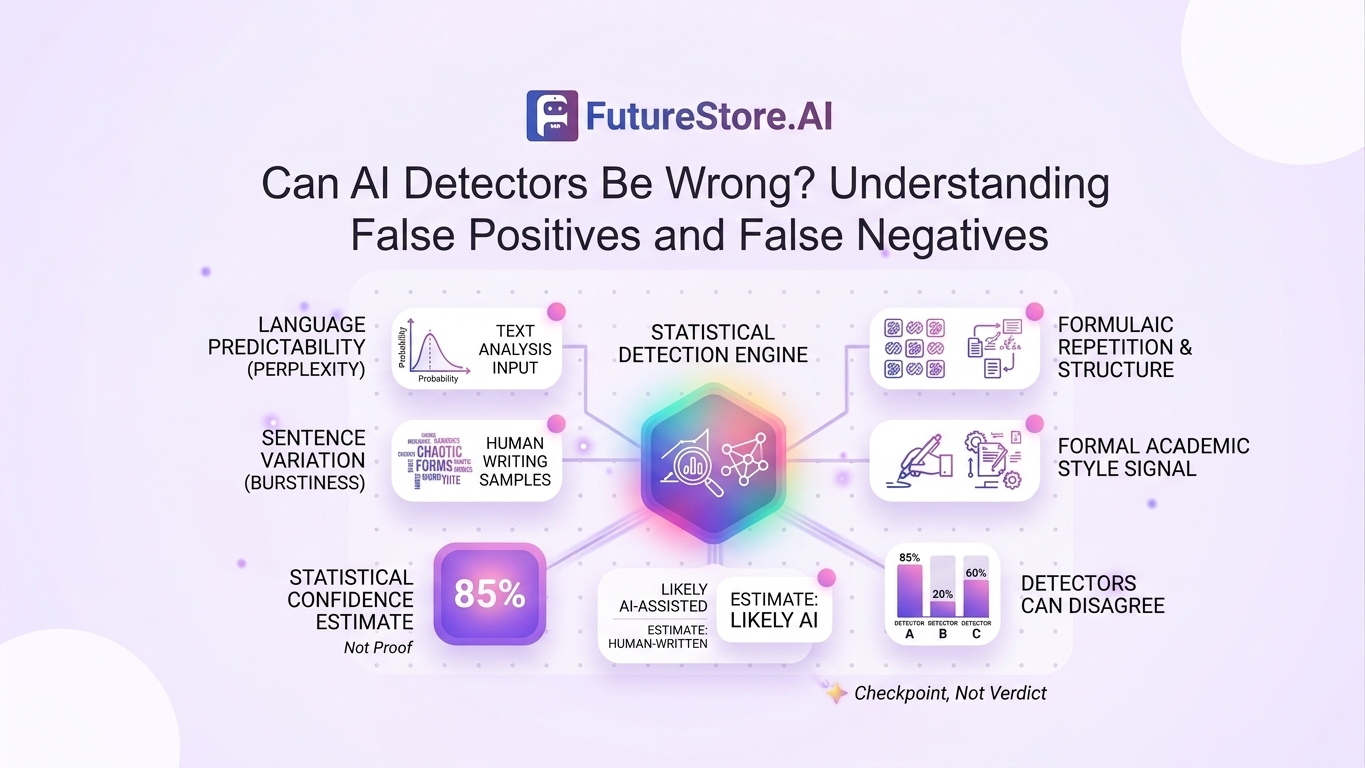
AI detection is inherently challenging because human creativity and machine outputs do not occupy entirely separate categories. Instead, there is a massive stylistic overlap between the two.
For instance, a human author naturally relies on several writing traits that AI models frequently mimic, including:
Predictable Syntax: Straightforward, simple sentence structures.
Standardized Vocabulary: Common, everyday word choices rather than obscure terms.
Formal Tone: Highly structured, academic, or corporate language.
Recurring Terminology: Repeating core keywords for technical clarity.
Rigid Formatting: Perfectly organized, highly linear paragraphs.
When human text displays these exact traits, an algorithm can easily misinterpret them as robotic, resulting in a false positive.
Conversely, AI-generated text that undergoes heavy human editing becomes more difficult for detection software to accurately classify. This leaves algorithms aiming at a moving target. As large language models continue to evolve and sound more natural, and as humans increasingly collaborate with AI tools, the boundary separating human writing from AI-generated content will continue to blur.
AI Detectors vs. Plagiarism Checkers
While AI detection and plagiarism tracking are frequently confused, they serve entirely different purposes and operate on completely different principles.
AI Detectors
An AI detector focuses on the linguistic and statistical patterns of your text. Instead of searching for matching content on the web, it uses advanced statistical modeling and machine learning to analyze writing patterns. The tool then delivers a final score estimating the likelihood of machine involvement. Because it looks for stylistic predictability rather than a specific text match, an AI detector cannot trace text back to a source URL, and it remains vulnerable to false positives, often flagging human text as AI-generated simply because it follows a formal or predictable structure.
Plagiarism Checkers
In contrast, traditional plagiarism checkers act as digital copy-trackers. They scan massive databases of indexed websites, academic journals, and books to identify identical or highly similar phrases. They typically report a similarity score and identify matching or closely related sources. While these systems excel at catching copied text, they can occasionally trigger false matches on common idioms, industry jargon, or standard citations.
The Core Difference
Because these tools look for entirely different indicators, content issues typically fall into two distinct categories.A piece of writing can be original but AI-generated, meaning it may bypass plagiarism checks while still being flagged by an AI detector. Conversely, content can be human-written but unoriginal, where a person genuinely creates text that accidentally mirrors an existing online source.
Recognizing which issue you are facing is essential to properly polishing and fixing your content before hitting publish.
How FutureStoreAI Fits Into This Workflow
AI content detectors are designed to analyze written content and identify patterns that may be associated with AI-generated or AI-assisted writing. These patterns can include word predictability, sentence structure, writing consistency, vocabulary choices, and other linguistic signals. However, detection results are estimates and should not be treated as definitive proof of authorship.
FutureStoreAI brings AI discovery, experimentation, learning, creation, and publishing together within a single ecosystem. Its AI Detector gives users a practical way to explore AI content detection and better understand how written content may be analyzed by AI detection systems.
For example, FutureStoreAI AI Detector allows users to examine a piece of text and use the detector's results as a starting point for understanding the patterns that may contribute to an AI-related detection signal. This can help creators, students, writers, marketers, and AI enthusiasts learn more about the relationship between writing style, AI-generated content, and detection technologies.
Rather than treating AI detection as an absolute measure of authorship, FutureStoreAI positions the process as an opportunity for exploration and learning. Users can compare different types of writing, review detection results, and consider how factors such as sentence structure, vocabulary, predictability, and writing patterns may influence the analysis.
It is important to remember that an AI detector score is only a signal. Human-written content can sometimes be incorrectly identified as AI-generated, while AI-generated or AI-assisted content may not always be detected. Therefore, the results are better understood as one source of context rather than a final judgment about how content was created.
Within the broader FutureStoreAI workflow, AI content detection can serve as a natural checkpoint in the creative process. Users can discover AI technologies, experiment with different tools, learn how they work, create content, review their work, and move toward publishing and sharing it.
Ultimately, FutureStoreAI connects AI discovery, experimentation, learning, creation, and publishing in one workflow, giving users a practical environment to explore generative AI and the technologies used to analyze AI-generated content.

Should You Trust an AI Detector Score?
While AI detectors are valuable diagnostic tools, their results should always be interpreted with nuance. An AI score is best used as a preliminary signal to encourage deeper review, rather than a definitive verdict on its own.
For instance, in an educational setting, an instructor looking to verify authenticity should look at a student's entire creative footprint instead of a single metric. A comprehensive review might include:
Drafting Progress: Version history and step-by-step document changes over time.
Brainstorming Footprint: Initial research logs, outlines, and foundational notes.
Linguistic Baseline: Cross-referencing the text with the author's previous writing samples.
Author Understanding: The creator's ability to explain their methodology, research process, and core concepts.
The Detector Output: Used strictly as one contextual data point among many.
This multifaceted approach paints a far more accurate picture than a standalone percentage. A similar principle can apply across enterprise businesses, digital publishers, and creative agencies.
Final Thoughts
AI content detection is a fascinating example of the ongoing relationship between artificial intelligence and human creativity.
The technology behind these tools is more sophisticated than simply searching for phrases associated with ChatGPT. Detectors can analyze statistical predictability, writing variation, stylistic characteristics, and patterns learned through machine learning.
Understanding these limitations is just as important as understanding what AI detectors can actually measure.
AI detection will continue to evolve alongside generative AI. As both sides become more advanced, understanding the technology behind detection will help users interpret results more responsibly.
Ultimately, the goal should not be to create content simply to satisfy a detector. The goal should be to create authentic, useful, well-researched, and meaningful content whether AI tools are part of the process or not.
Recommended for you
.png)
Introducing the New FutureStoreAI Overview: Discover What’s New in Our Latest Video Demo
A quick walkthrough of the latest FutureStoreAI updates, showcasing our searchable tool directory, built-in creation studio, real-time AI market analytics, and new creator feature set.

From Scattered Data to Qualified Leads: Building an AI Event Partnership Pipeline
How automated discovery, web scraping, data extraction, qualification, lead scoring, and CSV export turn scattered online information into structured partnership leads.
Can AI Detectors Be Wrong? Understanding False Positives and False Negatives
AI detectors can produce both false positives and false negatives. Learn how AI detection works, why results can vary, and why detection scores should be treated as indicators rather than definitive proof of authorship.